


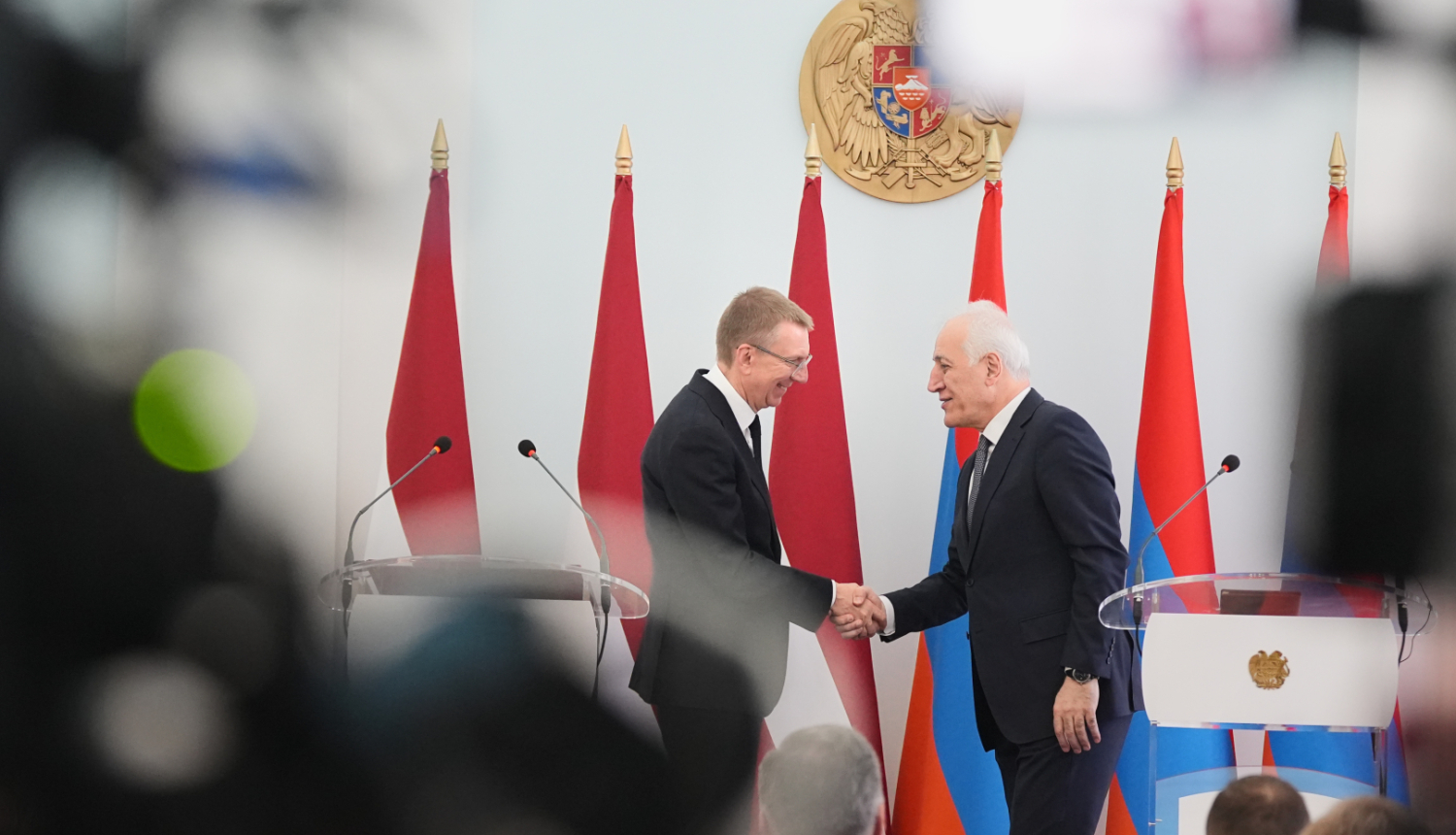
On 7 May 2026, the President of the Republic of Armenia, Vahagn Khachaturyan, and the President of the Republic of Latvia, Edgars Rinkēvičs, met in Yerevan during the official visit of President Rinkēvičs to the Republic of Armenia.
The Presidents noted the constructive and friendly relations between Armenia and Latvia and expressed their strong commitment to further strengthen political dialogue, inter-parliamentary ties and sectoral cooperation across a wide range of areas such as economy, trade, environment, culture, education, youth policy and others. Both sides underlined the importance of communication and consultations between the relevant ministries and agencies to foster institutional cooperation.
Emphasizing the importance of economic cooperation, the Presidents confirmed their interest in further strengthening contacts between economic actors and exploring investment and market opportunities across sectors of common interest, in particular, information technologies and digital innovation, transport and logistics, agriculture and food processing, and tourism. The Presidents also highlighted the importance of a predictable and conducive business and investment environment, mutual protection of investments, as well as continued cooperation to prevent and disrupt circumvention of sanctions of the European Union.
Underlining the efforts of the Armenian side, as well as the support delivered by the EU in building resilience against hybrid threats and foreign interference, the Presidents welcomed the decision to deploy a new CSDP mission to Armenia.
Acknowledging deepening ties between the European Union and Armenia, as well as the strategic objective of Armenia to further strengthen its political, economic, security and social ties with the EU and the wider community of democratic states, the Presidents highlighted the results of the first EU-Armenia Summit on 5 May 2026 as a historic milestone for further enhancing partnership between both sides. The Presidents reaffirmed their respective commitments under the Comprehensive and Enhanced Partnership Agreement between Armenia and the European Union (CEPA) and the new Strategic Agenda for the EU-Armenia Partnership. In this regard, the Presidents supported further advancement of the Visa Liberalisation Dialogue between Armenia and the EU, as well as continuation of the assistance to Armenia under the European Peace Facility.
The Sides emphasised the respect to the principles of democracy, human rights, and the rule of law and acknowledged Armenia’s commitment to comprehensive reforms and modernization, particularly in the justice sector and fight against corruption, to enhance resilience and prosperity of the country. The President of Latvia reaffirmed Latvia’s commitment to continue supporting these efforts by sharing its knowledge and expertise in different sectors, including data protection, food safety, media literacy and others.
The Presidents underlined Latvia’s role as an elected member of the United Nations Security Council (2026-2027) and reaffirmed their strong interest in sustained and close cooperation within the UN and other multilateral frameworks. The Presidents stressed the importance of upholding the principles of the Charter of the United Nations and adherence to international law. They emphasized the necessity of safeguarding a rules-based international order and multilateralism and reaffirmed respect for the sovereignty and territorial integrity of states. In this respect, the Presidents expressed their strong and continued support for the ongoing peace efforts in Ukraine and the Middle East.
President Rinkēvičs conveyed appreciation for Armenia’s humanitarian assistance to Ukraine. The Presidents also highlighted Latvia’s sustained and comprehensive assistance to Ukraine, exceeding 1 billion euros.
Recognizing the importance of regional connectivity, including the ongoing efforts to implement the Trump Route for International Peace and Prosperity (TRIPP), the Presidents underlined the strategic role of the Trans-Caspian Transport Corridor linking Europe and Asia. They discussed their interest in contributing to the further development of this and other regional and trans-regional connectivity projects, including “Crossroads of Peace” initiative, through the expertise and capabilities of their business communities, particularly in the fields of logistics, multimodal transport and digital solutions.