



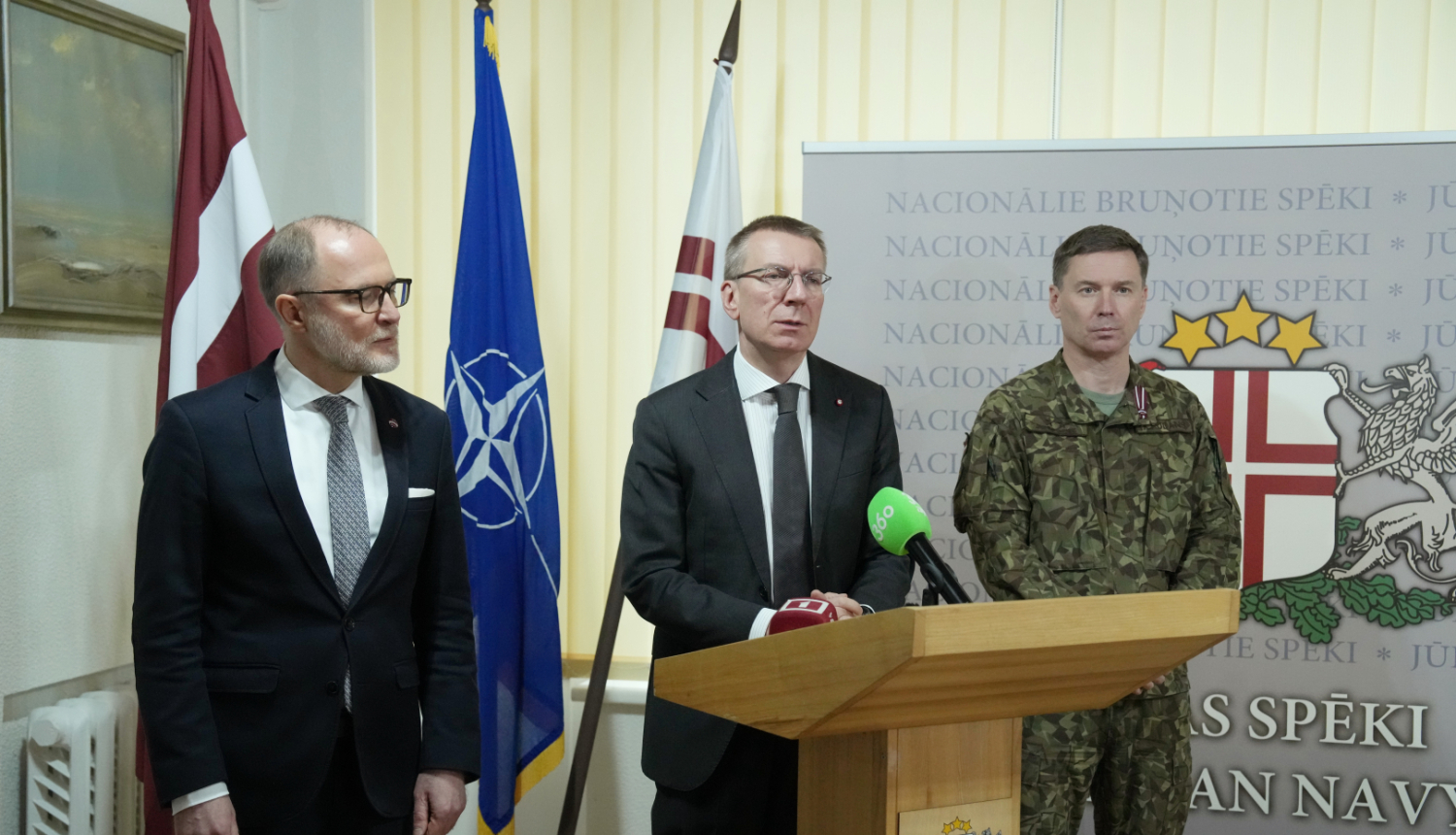
On 28 November, a meeting of the Military Council, chaired by President of Latvia Edgars Rinkēvičs, was held at the headquarters of the Naval Forces of the National Armed Forces in Liepāja.
The President received a briefing from the National Armed Forces on the implementation of counter-mobility measures, including the status of railway connections with Russia and Belarus, the potential risks these pose to national security, and possible solutions for mitigating and eliminating such risks. The Military Council discussed the need to prepare a comprehensive report detailing the timeline, scope of work, and resources required to ensure the most effective protection of Latvia’s eastern border.
The Military Council also underlined the importance of military coordination with Estonia, Lithuania, and within NATO, as well as inter-institutional cooperation in preparation for broader discussions in the Cabinet of Ministers and the National Security Council next year. At the same time, cooperation and communication with the public are also essential.
The President’s Military Council examined the current status of implementation of NATO capability targets, the resources needed to meet Latvia’s commitments, and the alignment of the defence expenditure proposed in the state budget for 2026 with the scale and deadlines required to achieve these objectives. The Military Council noted that currently the priority is to adopt the draft law “On the State Budget for 2026 and the Budget Framework for 2026, 2027, and 2028” in the Saeima to ensure adequate funding for strengthening national security.
Together with the Commander of the Naval Forces of the National Armed Forces, Flotilla Admiral Māris Polencs, the Council discussed the development of the Navy, with particular attention to the security situation in the Baltic Sea.
A separate discussion was also held between the President’s Military Council and Chairman of the Liepāja City Council Gunārs Ansiņš, with special focus on the development of military infrastructure at the Port of Liepāja, given its strategic importance for meeting the needs of both the National Armed Forces and allied naval vessels.
