


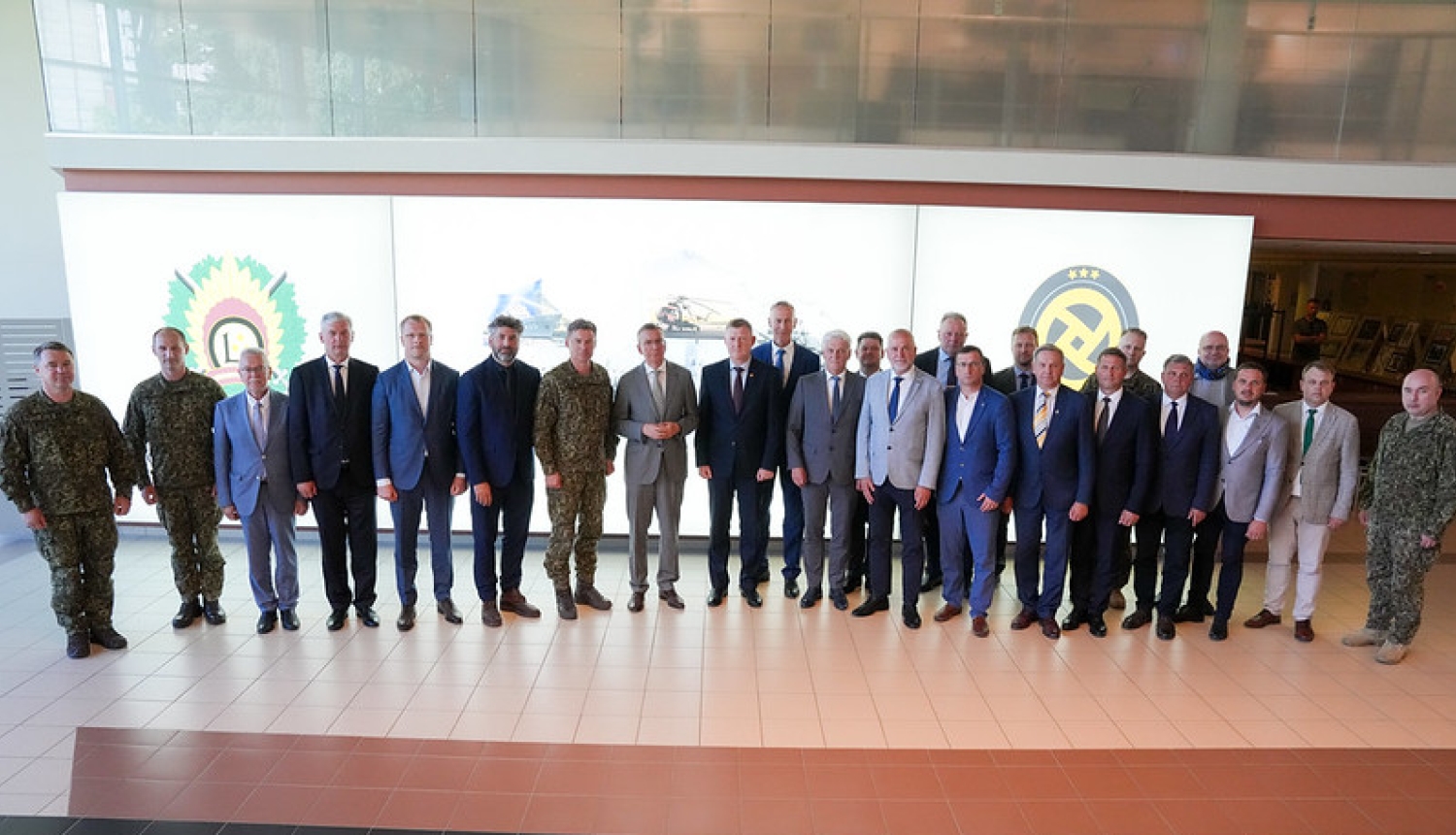
On 25 June, a meeting of the Military Council, chaired by President Edgars Rinkēvičs, took place at the Joint Headquarters of the National Armed Forces in Riga.
The President received a briefing from the National Armed Forces on the development of military capabilities and the enhancement of the capacity of the professional service, the National Guard, and the National Defence Service, including human resources, infrastructure, and armaments.
In light of the NATO Heads of State and Government Summit to be held in Ankara, Türkiye, on 7–8 July this year, where the Latvian delegation will be led by President Edgars Rinkēvičs, a key topic of discussion at the Military Council meeting was the fulfilment of NATO capability targets by all Allies. The Minister of Defence, as well as the Commander of the National Armed Forces and other military representatives, provided an update on the extent to which NATO capability targets correspond to Latvia’s immediate and priority defence requirements, particularly with regard to the rapid deployment of unmanned aerial vehicles and counter-drone systems, as well as the necessary reallocation of resources within the existing defence budget.
A meeting between the President’s Military Council and municipal leaders from the Latgale and Vidzeme regions was also held at the Joint Headquarters of the National Armed Forces. During the meeting, representatives of the National Armed Forces provided an update on the current security situation and assessments of the threat posed by Russia, including in the context of Russia’s continued aggression against Ukraine. The main focus was on developing of the National Armed Forces’ air defence capabilities, the strengthening of the Baltic Defence Line, and the deployment of counter-mobility infrastructure along Latvia’s eastern border. During the meeting, which was also attended by the commanders of the National Guard’s 2nd Vidzeme Brigade and 3rd Latgale Brigade, participants discussed cooperation between the National Armed Forces and local governments in the Vidzeme and Latgale regions, as well as the role and responsibilities of municipalities.
“Regular dialogue, close coordination, and the exchange of information with municipalities are essential elements in strengthening national security and enhancing preparedness for crisis situations. Incidents involving unmanned aerial vehicles and the air-raid alerts declared in a number of municipalities have already prompted a review of existing procedures and highlighted the work that still needs to be done in the area of civil-military cooperation. It is important to continue cooperation both with the defence sector and institutions of the Ministry of the Interior, particularly in matters relating to civil protection,” emphasised E. Rinkēvičs.
The meeting was attended by municipal leaders from the municipalities of Augšdaugava, Alūksne, Balvi, Gulbene, Jēkabpils, Krāslava, Ludza, Madona, Preiļi, Rēzekne, Smiltene, Valka, and Valmiera, as well as representatives of the state cities of Daugavpils and Rēzekne.
