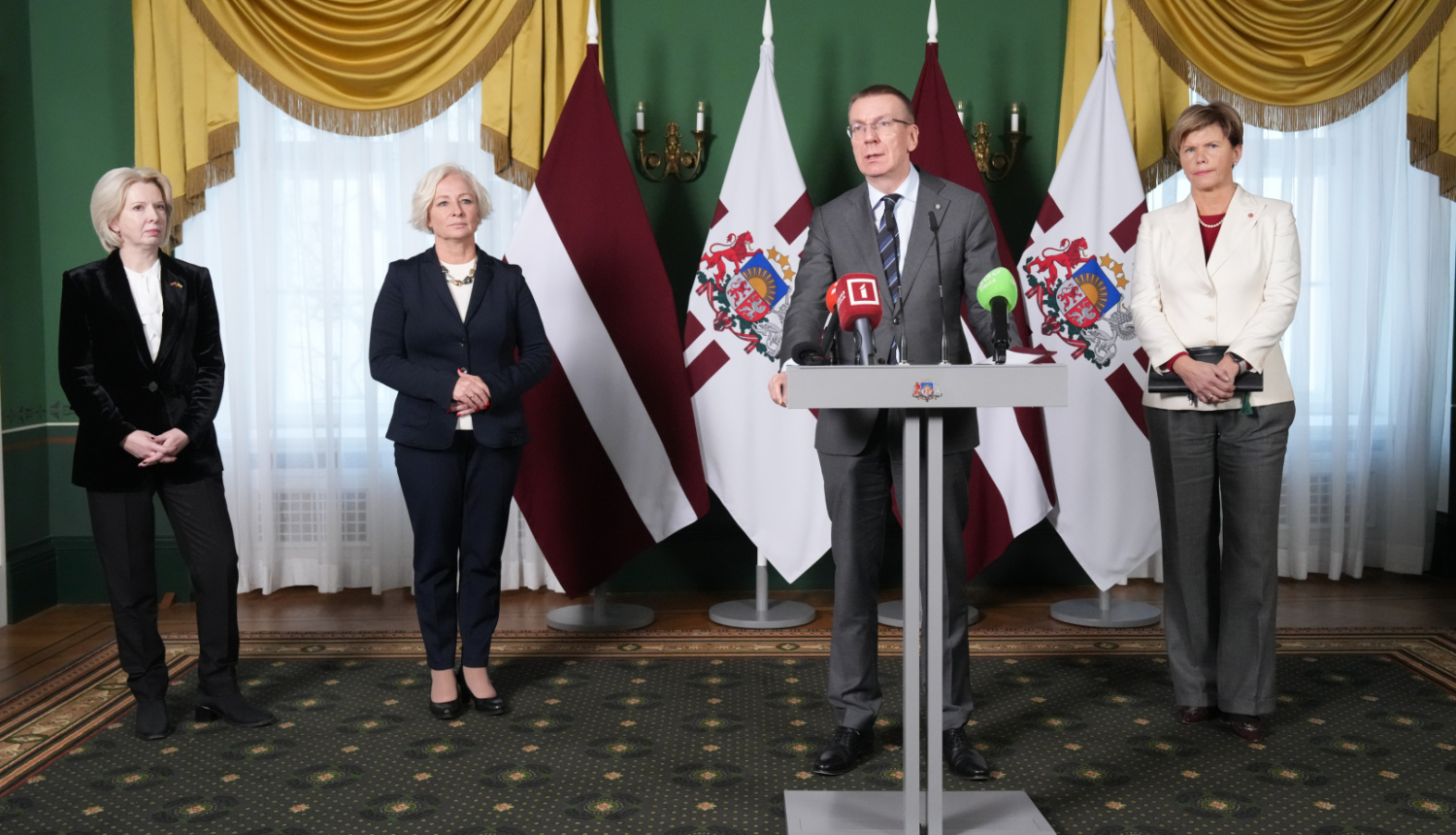
On 23 January, under the leadership of President Edgars Rinkēvičs, a meeting of Latvia’s senior state officials involved in the implementation of foreign policy was held at the Riga Castle. The meeting focused in particular on transatlantic relations and cooperation among the Baltic Sea countries in the field of security, the defence of Latvia’s interests in negotiations on the European Union’s Multiannual Financial Framework (2028–2034), as well as on a stricter EU migration policy.
The senior state officials positively assessed the news of the agreement reached in Davos between NATO Secretary General Mark Rutte and US President Donald Trump to strengthen Arctic security within the framework of NATO’s collective defence and to continue US–Danish talks on Greenland.
“Greenland is an integral part of Denmark. It is important to continue direct and open dialogue and find a mutually acceptable solution, strengthening security in the Arctic and thereby also the overall security of the NATO Alliance. Latvia will support all necessary NATO activities aimed at strengthening Arctic security,” the senior state officials agreed.
During the discussion, officials emphasised the need to build a secure Europe and maintain close transatlantic relations, highlighting the vital role of the United States in Euro-Atlantic security. At the same time, Latvia must continue to prioritise security cooperation with the Nordic countries, the Baltic states, Poland and Germany, as well as with the countries participating in the UK-led Joint Expeditionary Force (JEF) cooperation framework. The role of NATO’s multinational brigade in Latvia’s security is highly valued, with particular emphasis placed on Canada’s leadership, as well as on the role of the Danish-led NATO Multinational Division Headquarters “North” in the defence and strengthening of the Baltic states.
The senior state officials involved in the implementation of foreign policy reaffirmed Latvia’s unchanged position that comprehensive support for Ukraine must continue, including the allocation of 0.25% of gross domestic product to Ukraine’s military assistance, the continuation of support for Ukraine’s reconstruction and for Ukrainian civilians in Latvia, as well as support for Ukraine’s Euro-Atlantic integration.
The officials condemned Russia’s attacks against Ukraine, including attempts to destroy Ukraine’s energy infrastructure, causing immense suffering to civilians. The officials agreed that Russia is not ready for peace and that diplomatic and economic pressure on Russia must therefore continue to be increased, particularly through sanctions, as well as through continued support for the resilience of Ukraine’s energy sector and the swift restoration of infrastructure following Russia’s targeted attacks.
The senior state officials also confirmed that the defence of Latvia’s interests in negotiations on the EU Multiannual Financial Framework (2028–2034) is a key national priority, requiring coordinated efforts by the responsible officials and sectoral ministries. Among the key interests to be advocated in the EU budget negotiations, particular emphasis was placed on ensuring equal competitive conditions for farmers and on additional support for EU eastern border countries, taking into account the threats posed by Russia and Belarus.
The officials also agreed on the need to pursue a strict EU migration policy, advocating for increased control of the EU’s external borders and the limitation of migration flows.
The officials involved in the implementation of foreign policy underscored the importance of a unified foreign policy and close mutual coordination in order to defend Latvia’s interests as effectively as possible.
The meeting was attended by President Edgars Rinkēvičs, Speaker of the Saeima Daiga Mieriņa, Minister for Foreign Affairs Baiba Braže, Chair of the Saeima Foreign Affairs Committee Ināra Mūrniece, and Adviser to the Prime Minister on Foreign Affairs Ivars Liepnieks, representing Prime Minister Evika Siliņa, who is participating in an extraordinary informal meeting of the European Council.
For information:
The meeting of the senior officials of the Latvia involved in the implementation of foreign policy, the so-called "Big Five", is a traditional coordination meeting organised by the President of Latvia to ensure a unified and coordinated foreign policy.
