


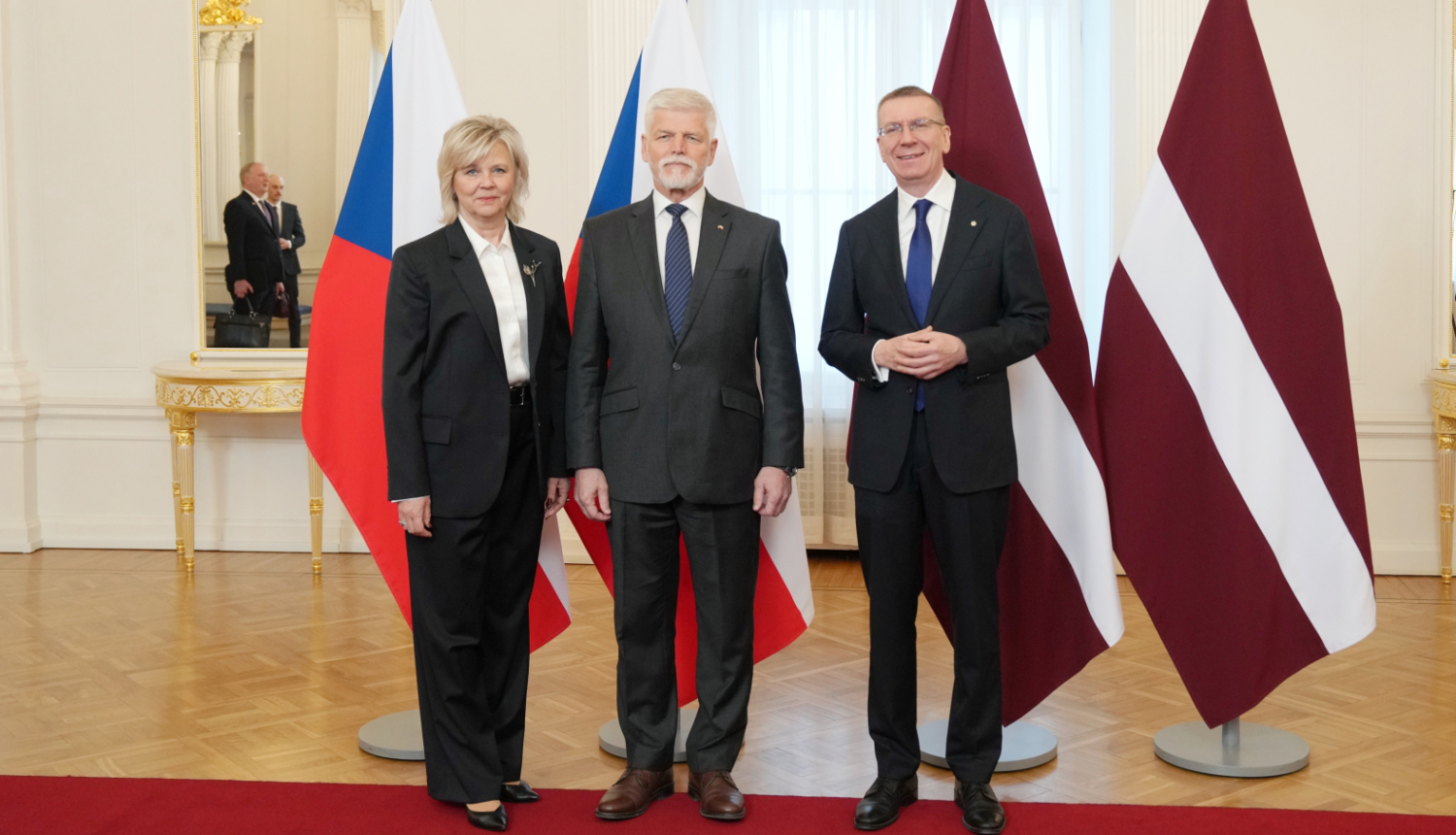
On 10–11 March, the President Edgars Rinkēvičs welcomes the President of the Czech Republic, Petr Pavel, and his spouse Eva Pavlová on a state visit to the Republic of Latvia. During their meeting at the Riga Castle, the two presidents discussed bilateral cooperation, particularly strengthening NATO capabilities, support for Ukraine against Russia’s aggression, the situation in the Middle East, and the prospects for transatlantic relations.
It is my sincere pleasure and honour to welcome you on your state visit to Latvia! This is a special visit. The last time we had the honour of hosting a Czech President on a state visit was exactly thirty years ago, when President Václav Havel visited Latvia. Both then and now, the Czech Republic and Latvia share a great deal in common. The pages of our nations’ histories are remarkably similar. We are peoples who freed ourselves from empires. Gained independence. Lost that independence. Resisted and endured fifty years behind the Iron Curtain. We ultimately regained our statehood and freedom. We returned to where both Latvia and the Czech Republic have always belonged – Europe. Today we stand shoulder to shoulder in defending our interests within the European Union, NATO and other international institutions. The Czech Republic is an important ally and partner for Latvia. The historical experience of our region reminds us that freedom, democracy and security must be cherished and protected. I would like to express my gratitude for the Czech Republic’s contribution to strengthening the security of Latvia and the Baltic region,” President Rinkēvičs emphasised during the meeting.
The President of Latvia noted that bilateral relations between the two countries are very good, as both are like-minded partners in the European Union (EU) and NATO. “Our countries share a common understanding of global challenges. Latvia is grateful for and highly values the Czech Republic’s participation in the NATO Multinational Brigade Latvia. I can confirm that Latvia will continue to invest in strengthening its defence capabilities and providing host nation support. We are ready to host an even greater Czech presence. We also greatly appreciate the Czech Republic’s contribution to Ukraine’s defence by participating in the drone coalition and continuing to lead the Ammunition Initiative for Ukraine,” E. Rinkēvičs emphasised during the discussion.
During the meeting, E. Rinkēvičs also highlighted Latvia’s interest in strengthening cooperation with Czech defence industry companies. The President expressed satisfaction that a Latvian–Czech business forum was taking place during the visit, opening new opportunities for expanding trade links. Given that the Czech Republic is a popular destination for Latvian tourists, direct airBaltic flights from Riga to Prague help foster direct contacts between citizens and businesses of both countries.
The parties discussed the upcoming NATO Summit, which will take place in Ankara on 7–8 July this year. The President of Latvia informed that Latvia will allocate 4.91% of its gross domestic product (GDP) to defence this year. At the President’s initiative, it is planned to further enshrine in the National Defence Financing Law a commitment to invest no less than 5% of GDP in defence from 2027 onwards. E. Rinkēvičs expressed his conviction that at the NATO Summit in Ankara it will be important for Allies to demonstrate the progress made by European Allies in increasing defence spending and implementing NATO capability targets, to promote faster development of the transatlantic defence industry, and to continue providing long-term support to Ukraine. It is equally important to strengthen air defence. This is confirmed both by the lessons learned from Russia’s war against Ukraine and by the current situation in the Middle East. Collective efforts must continue to contain the development of Russia’s military capabilities and to limit Russia’s hybrid threat activities, including the operations of its so-called “shadow fleet”.
Speaking about Russia’s aggression against Ukraine, the President of Latvia stated that Russia has so far shown no meaningful engagement in the peace process. Therefore, pressure on the aggressor must be increased, including through sanctions. In this context, it is important to reach agreement as soon as possible on a strong 20th package of EU sanctions against Russia, targeting the sectors that generate its revenues: energy, financial and military-industrial, as well as preventing sanctions circumvention.
The two presidents also discussed the situation in the Middle East. The President of Latvia noted that Iran has long pursued an aggressive foreign policy, posing a threat to the security of the region and other countries. Iran has also for a long time supported Russia’s aggression against Ukraine, enabling Russia to terrorise Ukraine’s civilian population and destroy civilian infrastructure. Latvia will continue to stand for the legitimate rights of the Iranian people to determine their own future free from violence and repression.
