



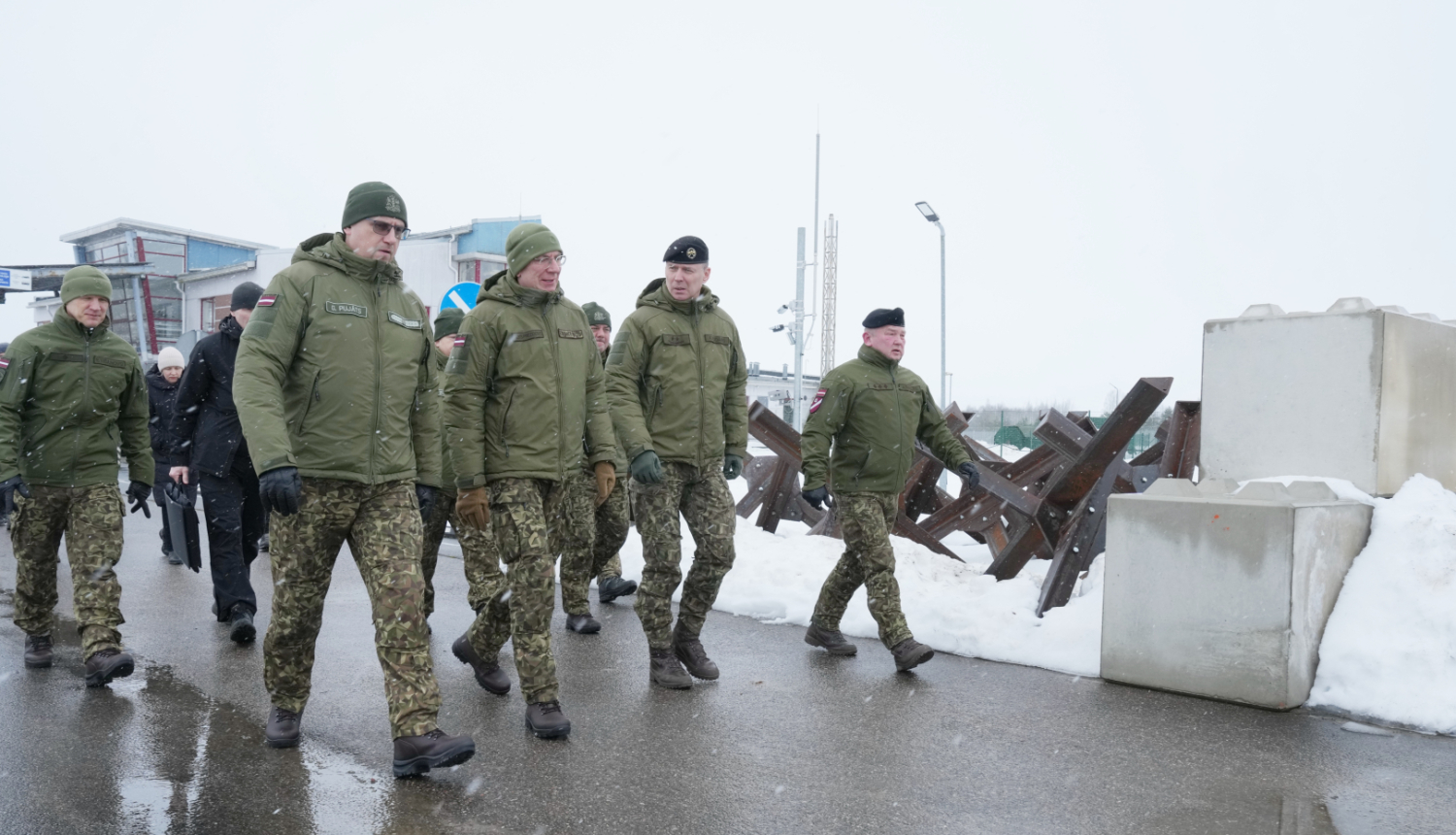
On 2 March, the President Edgars Rinkēvičs together with the Commander of the National Armed Forces, Major General Kaspars Pudāns, and the Chief of the State Border Guard, General Guntis Pujāts, visited the Latvia–Russia border within the area of responsibility of the State Border Guard’s Viļaka Administration, in the municipalities of Alūksne and Balvi.
The President began his visit by familiarising himself on site with the work of the Pededze Border Guard Unit and inspecting the border fence, the construction of which along the entire eastern border of the country was completed at the end of 2025. At the Latvia–Russia border section near the parish of Liepna, the President reviewed border infrastructure adapted to marshland terrain. He also received briefings from representatives of the state joint-stock companies “Valsts nekustamie īpašumi” and “Latvijas Valsts radio un televīzijas centrs” on the progress of the construction of technological infrastructure for border protection.
At the same time, representatives of the National Armed Forces informed the President about the anti-mobility obstacles and logistical resources already deployed at the closed border crossing points “Pededze” and “Vientuļi”, and outlined further plans for the military reinforcement of the Latvia–Russia border.
“The completed border fence is an important physical barrier on our country's eastern border, however, border security and defence must be strengthened in a purposeful and consistent manner every day. By the end of this year, it is essential to complete the implementation of technological solutions for border monitoring along the entire length of the border. It is equally important to continue expanding anti-mobility measures to enhance border defence, as well as to deploy radar and air defence systems. Geopolitical tensions are here to stay for the long term, therefore we must prepare for various scenarios in a timely and well-organised manner. We are already facing hybrid warfare activities, and with the spring thaw, illegal migration pressure is also resuming on the Latvia–Belarus border,” said E. Rinkēvičs.
The President underlined the importance of close cooperation between the National Armed Forces, the State Border Guard and local authorities, including explaining to the public the impact of anti-mobility measures.
