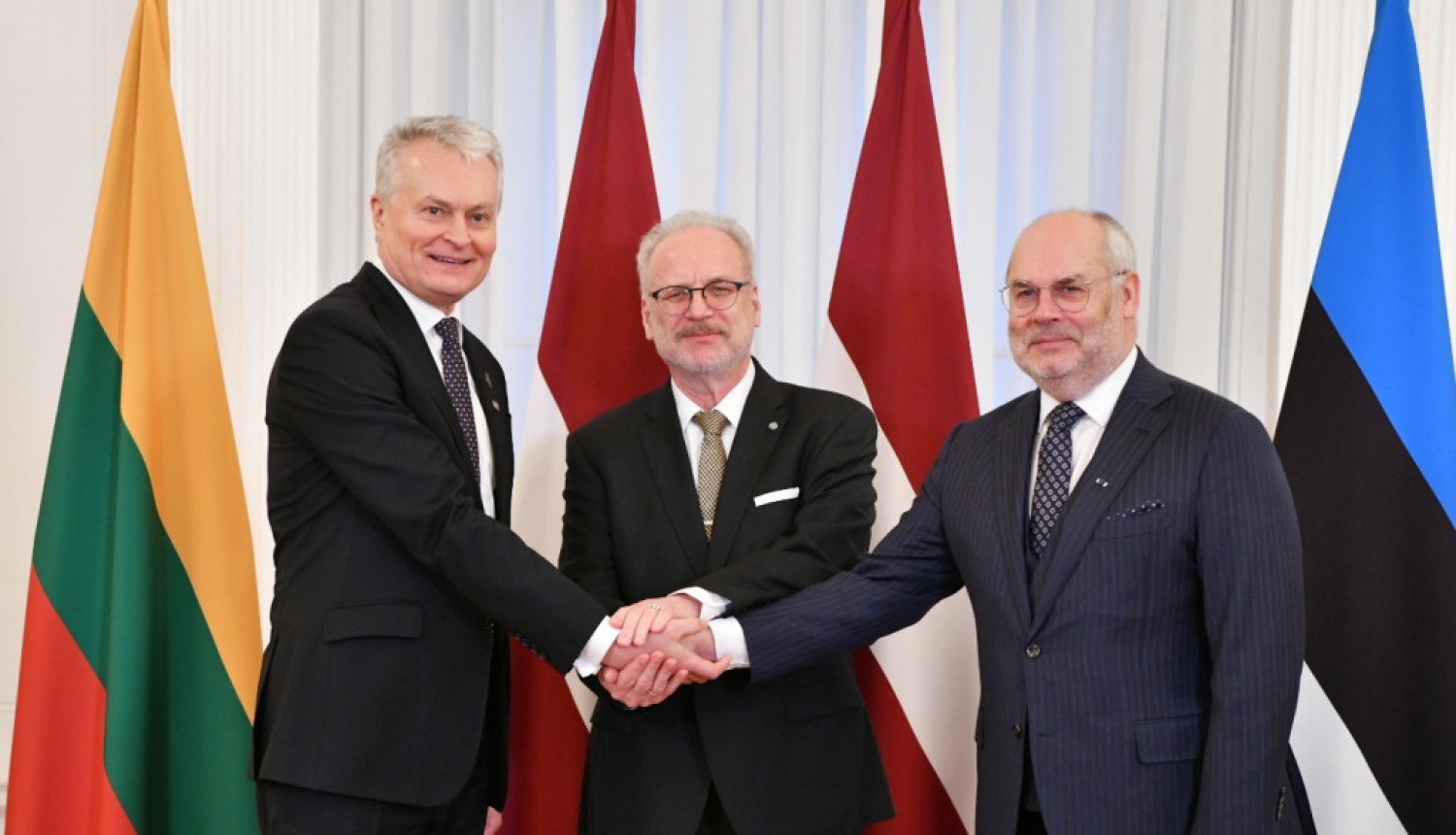
On 19 December, presidents of Latvia, Lithuania and Estonia met at the Riga Castle during annual summit of the Baltic heads of state. Presidents of all three Baltic States confirmed support for international tribunal to investigate Russia’s responsibility for war in Ukraine. Following the press conference, heads of Baltic States went to Āgenskalns to take part in a symbolic candle-making workshop. These candles will be sent to the frontline of war in Ukraine.
Statement by the President of Latvia Egils Levits
Today, I had the pleasure of hosting the meeting with my Baltic colleagues – President of Estonia Alar Karis and President of Lithuania Gitanas Nausėda – at the Riga Castle.
I want to thank Estonia and Lithuania, and both of my Baltic counterparts personally, for the regular meetings in different formats that we have taken part in, supporting common and coordinated position regarding the issues important for the Baltics, Europe and global security.
Security is obviously the main priority right now. We discussed current security challenges. It is vital for us to remain united in the framework of NATO. We also discussed the future of Allied presence in the Baltics and increased forward presence in Estonia, Latvia and Lithuania. We also talked about the homework we need to do to boost our national security.
Let me remind you that, following the NATO Madrid Summit, we have decided to build a new training area. It is an important task that we need to complete to be able to host the brigade-size NATO battle group, which will become operational in the coming years.
We also discussed Russian aggression against Ukraine and how we are going to ensure continued and increased support to Ukraine. Our meeting also focused on European Union (EU) perspective for Ukraine and, of course, its eventual membership in NATO. We believe the West must continue to provide general support to Ukraine and we, the three Baltic States, will remain at the forefront of such support.
Creation of international tribunal to investigate Russia’s crimes of aggression against Ukraine was another topic we discussed. We agreed on the need to create such tribunal.
During the meeting, we exchanged views on regional economic cooperation and construction of Rail Baltica in particular. This is a project supported by the European Union who is also the biggest financial contributor to its implementation. In the beginning this project was primarily economically oriented. Economic component is still strong. However, the new security situation has made it our strategic military project that bears crucial importance for us. We agreed to do our best to speed up the implementation of Rail Baltica as much as possible to have it completed ahead of schedule.
Desynchronization is another project that needs to be fast-tracked. It is scheduled for 2025 but we will make additional efforts to complete it sooner and ensure our energy independence from Russia as soon as possible.
Our countries have built extremely good and strong political and economic ties. There is, however, untapped potential when it comes to developing our economic cooperation in various areas. It is important for the Baltics to remain united. Together we can move European Union agenda forward in areas that are particularly crucial for us and areas that are significant for the whole Europe.
Once again, I thank my Baltic colleagues for this constructive meeting.
