


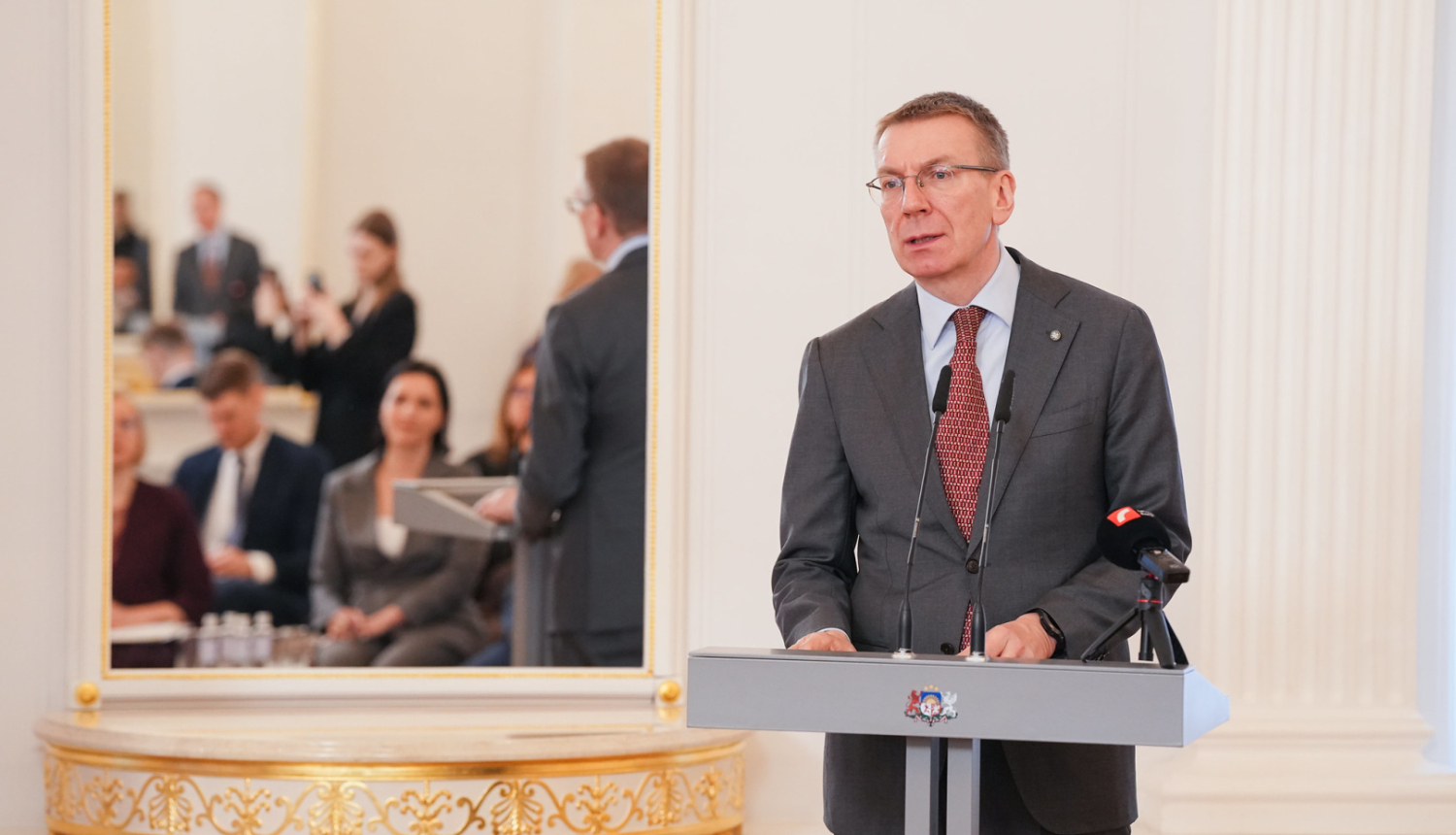
Welcome to the Riga Castle!
It has been a year since we first met with experts and politicians at the government and parliamentary levels to discuss the urgent tasks and priorities in the field of demography. In essence, we are looking at three major challenges and directions for development – security, democracy and the competitiveness of the state, which, in my view, are of crucial importance. Without security, we cannot speak about attracting investment or stable economic development. Without people, we cannot speak about economic development because there is no one to work. Finally, without people there will be neither economic development nor national security.
Looking back on this past year, I must say that I am pleased that on several issues we discussed and agreed upon here, the Saeima and the government have subsequently taken decisions – both on increasing national defence expenditure and on support for demography and families, as well as funding for healthcare support. However, the measures have not been as extensive or sufficient as we discussed here.
Today’s discussion is not intended to complain how bad the situation is. We already know quite well how serious it is, because according to the data available to me, if the current demographic trend continues, by 2040 we will see an even greater decline. In fact, we will lose another 15% of the country’s population, which is approximately 270,000 people. If today we speak of 1.8 million inhabitants, then we will be speaking of 1.5 – 1.6 million people living in Latvia. At the same time, as we all understand, there is no magic wand that could solve all problems within one, two or three years.
If we start this year and if we consistently continue policies to support families, concentrate investments in healthcare and provide support through housing policy, then perhaps we will see the first results within the next three to five years. The current task of halting this trend therefore remains in force. In 2025, fewer children were born in Latvia than in 2024.
Among the positive developments, I would like to highlight the decisions that have been taken – financial support for families, the childbirth allowance, the childcare allowance, and the expansion of the range of family support measures. A total of EUR 74 million has been allocated for this purpose in this year’s state budget. In reality, we are talking about the need for almost exactly twice that amount. One piece of good and important news for people is that a regular review of the state benefit has been established every two years.
The situation is slightly better in the health sector. While the Ministry of Health had initially planned EUR 13.8 million, this year’s budget allocates EUR 20.9 million to the maternal and child health support programme and to support for medicines. However, this still does not resolve many of the existing issues.
Finally, state support for housing is also not funded at a sufficient level.
We can see some modest progress. I do not think that only two months after the adoption of the budget we can already assess any concrete benefits. The main objective of today’s discussion is to understand what the most urgent tasks are as we begin planning next year’s budget, and which ideas from experts should be taken up by political parties and policymakers. Frankly speaking, this is the moment when I would encourage these ideas to be put on the table, and for the political parties that will take part in the elections to consider which of them should be included in their election programmes and subsequently implemented, because this issue will not disappear. This should be an exchange of ideas about the next urgent tasks and the programmes that must continue and for which funding must be secured in next year’s budget.
I know that the Ministry of Welfare has several proposals, as do non-governmental organisations. Of course, the maximum scope of programmes can never be achieved in full. However, if there is a consistent trend of moving forward, if every year new opportunities and ideas are identified, then in a few years there should be results.
Of course, additional factors such as the sense of insecurity and economic growth also come into play. Naturally, we are pleased that economic growth last year was stronger than expected. Current developments in the Middle East may affect our region, economy and national security. We cannot predict or analyse everything, and there are many factors beyond our control.
Therefore, the purpose of this discussion is to understand where to go from here. My overarching task is to encourage discussion and the exchange of ideas. A year ago, I said that this issue would remain in the focus of the Riga Castle and the institution of the President of Latvia, and today’s discussion is proof of that. There will be another discussion next year, with a new Saeima and Cabinet of Ministers, experts and politicians who will continue their work.
At least over the next five to seven years, we must consider what needs to be done and how demographic policy can be transformed from a campaign-based approach into a systemic policy, in the same way as we approach national defence and security.
The issues that, in my view, should be discussed include the further strengthening of families and family benefits, while recognising that benefits alone will not solve all problems. The second issue concerns what must be done in health policy. The third concerns housing policy. We know that some experts argue that demography must also be considered in the context of migration policy. Here we are well aware of the challenges we currently face, and this is an extremely sensitive issue.
If we look at the economy as a whole, at demography as a whole, and at what we can and cannot do, then the discussion must cover the entire spectrum and seek to understand what is and is not acceptable to society. What the state can do and what it cannot.
I hope that we will have an interesting and productive discussion, just as we did last year. Not everything was achieved, but certain results have been attained. This is the next stage in preparing for the next budget year, the next political cycle, and the next cycle of national development.
