



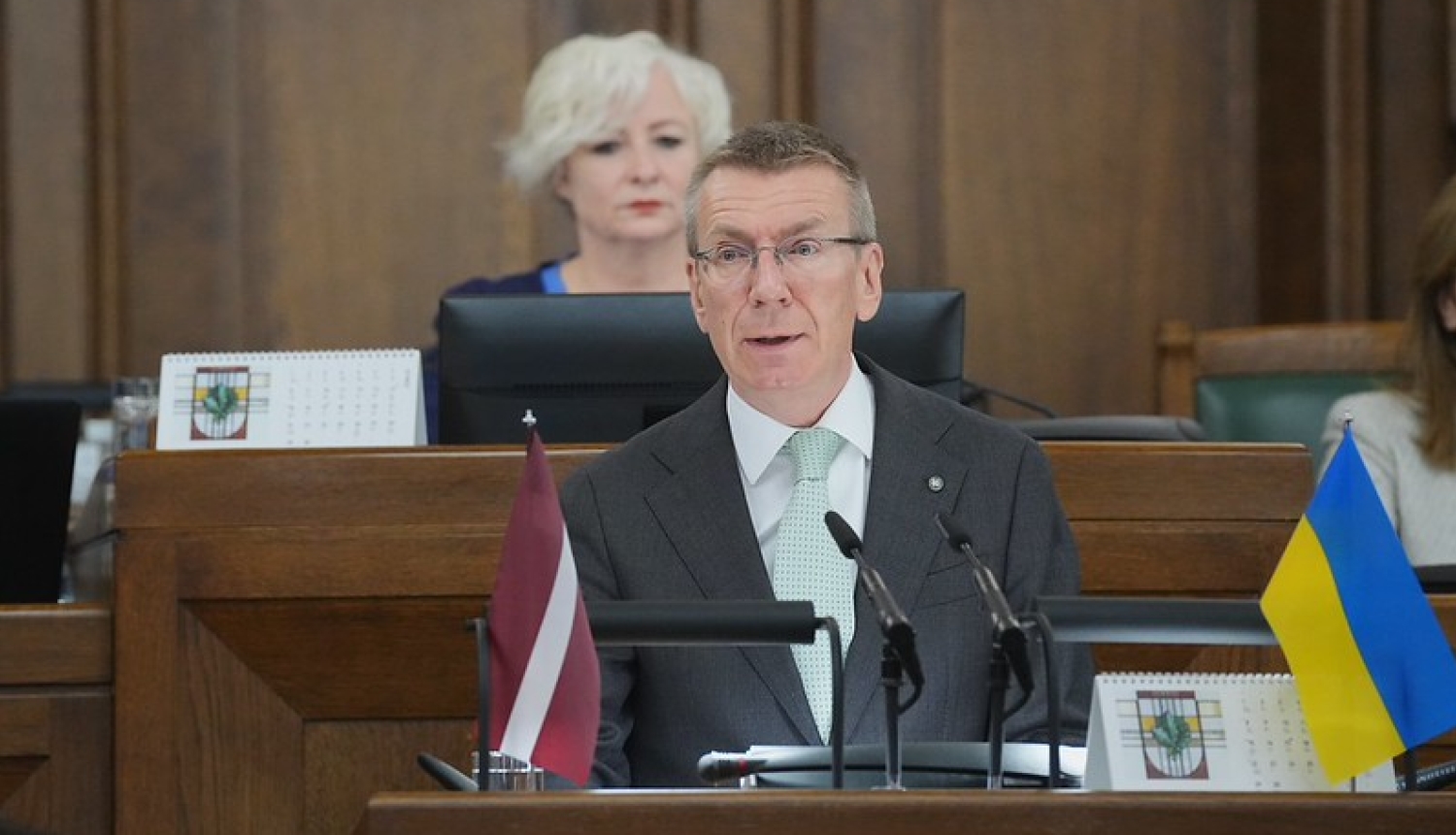
Madam Speaker of the Saeima!
Distinguished members of the Saeima!
Ladies and gentlemen!
The 14th Saeima convened for its first session in 2022. Regrettably, that year will forever be remembered for Russia’s full-scale invasion of Ukraine. It irrevocably altered the security landscape not only of Latvia, but also of Europe and the wider world.
I am fully convinced that each of you entered this chamber nearly four years ago with a determination to make Latvia better. The election campaign has begun early this time. We do not yet know what the outcome of this year’s elections will be. However, we do know very well what people voted for four years ago. They voted for you. You were given the opportunity to demonstrate and prove your abilities. I believe that each of you has experienced moments of satisfaction as well as moments of disappointment. Yet there is still work to be done. This Saeima still has much to accomplish.
Today, I would like to express my sincere gratitude to the members of the 14th Saeima for your constructive work in strengthening Latvia’s security. The Law on the National Defence Service has been adopted. Investment in national defence has been increased and is set to reach five per cent of the gross domestic product. The Law on the Establishment of Anti-Mobility Infrastructure has also been enacted.
The 14th Saeima has devoted attention not only to physical security, but also to other issues that are inseparably linked to national security. Amendments have been made to the Criminal Law, introducing more severe penalties for offences against national security. A requirement has been established for municipal leaders to obtain security clearance for access to state secrets. Legislation has also been adopted providing for the establishment of the Crisis Management Centre.
National security also encompasses our democratic values. This Saeima has been capable of taking decisions that strengthen these values. Decisions that affirm the state’s respect for the fundamental rights of every individual. If we wish society to trust public institutions, we must be able to demonstrate that the state itself trusts its people. We can achieve this not only by reducing bureaucratic oversight, but also by respecting the diversity inherent in a democratic society, combating violence, and strengthening our legislation accordingly.
I would also like to thank every member of Parliament whose work helps strengthen Latvia’s ties with its allies, both near and far. Close cooperation with the parliaments of other countries is not merely a formality. It is a direct contribution to our national security, particularly at a time when the geopolitical situation, both globally and in our own region, is becoming increasingly complex and dangerous.
I am also grateful for the Saeima’s unwavering support for Ukraine. Your principled stance and commitment, both in assisting Ukraine and in supporting Ukrainians here, are recognised and appreciated in Latvia, in Ukraine, and around the world. This support encourages Ukraine to deepen its cooperation with us and to share the invaluable experience from which we have so much to learn.
Honourable members of the Saeima!
It seems that no one questions the fact that our national security remains an unwavering priority. However, we must change the pace and speed at which we adapt to the realities of the present day.
It is clear that security is a process. It can never be absolute. There is no single miracle weapon or silver bullet, nor will there ever be. Technology is evolving more rapidly than our thinking and, indeed, more rapidly than our procurement procedures. Therefore, we must continue to learn and adapt. This is not merely a matter of procedures; it is a matter of changing our mindset. We are not living in a time of war, yet neither are we truly living in a time of peace. We are living in a time of uncertainty and preparation in order to prevent the worst possible scenarios.
Our National Armed Forces are adapting to this reality. So too are our internal security and law enforcement institutions, our defence industry enterprises, our municipalities, and the operators of critical infrastructure.
The “two-wall principle” is not merely a physical solution in the event of a threat. Each of us must understand it metaphorically as a strategy of preparedness for various scenarios, as readiness for layered defence. Any contingency “Plan B” does not mean an inevitable reality. It is, by nature, the “second wall” that strengthens our preparedness.
That is why it is important that, during the months remaining until the election of a new Saeima, we have a fully functioning Cabinet of Ministers. The current government has clear priorities – national security and the national economy. I wish it every success in delivering on these priorities, as they are of vital importance to all Latvian society. During the term of this Saeima, the Cabinet led by Andris Kulbergs is already the third government to take office. This is also an appropriate moment to express gratitude to the two previous Cabinets – those led by Krišjānis Kariņš and Evika Siliņa – for their contribution to our national security and development.
Honourable members of the Saeima!
Secure parliamentary elections cannot be taken for granted. In a number of European countries, Russia has sought to interfere in electoral processes. It would be naïve to believe that it is now dormant. Fair and secure elections are the very foundation of democracy. We also know that our experience in recent years has not always been straightforward.
We have witnessed drones entering Latvian airspace and, in all likelihood, we may witness similar incidents again. We have also seen drones being intercepted by fighter aircraft of our NATO Allies. At the same time, we have seen how such incidents affect residents living in border regions. Regardless of drones or any other unforeseen developments, people cannot wait for the next Saeima or government. The people of Latvia want reassurance that today an explosives-laden drone will not strike their homes, kindergartens, or schools. They want to know how to act in such circumstances. They want to know what assistance and support will be available should a tragedy occur. Not every decision can be made or dictated from Riga. What citizens expect from the government and the responsible authorities are clear action protocols. Yet the real application of those measures will depend on every individual, every municipality, and every business.
This is also an appropriate moment to express our sincere gratitude to our allies who stand alongside us here today. We may thank them for their support, yet we also fully understand that it is our own responsibility to develop and strengthen the capabilities necessary to deter and counter threats.
Esteemed members of the Saeima!
Security cannot be separated from the competitiveness of the state. It affects investment. It affects business activity. And it is businesses that, through the taxes they pay, help to finance the needs of our country.
Over the past four years, the Saeima has taken a number of important steps to enhance Latvia's competitiveness. Bureaucratic obstacles in the construction sector have been reduced. Public procurement procedures have been improved. The concept of an Artificial Intelligence Centre has been developed. The Biobanks Law has been adopted, a measure of particular importance for the development of Latvian science and research.
At the same time, there are troubling trends that must be addressed. Investigations conducted by law enforcement authorities into information technology procurement projects and other matters, along with a lack of transparency in the governance of state-owned enterprises, have raised legitimate concerns regarding the effective use of national and European Union funding. Of course, we await the results of these investigations, and the courts will have the final say. Yet we cannot expect public trust in state institutions, or the willingness of businesses to pay taxes, to increase or even be maintained if such scandals continue to arise. It is clear now that there is a problem which cannot and must not be ignored, not only for the sake of democracy or efficiency, but also in the interests of national security. That problem is corruption. The Saeima must also put an end to any doubts as to whether prohibited collusion in public procurement constitutes a criminal offence. It does. Such conduct is criminal and must be treated accordingly.
Competitiveness, however, is not only about legislation, it is about people. Latvia is not lacking in enterprising, intelligent, and ambitious individuals, ambitious in the best sense of the word. It is the responsibility of all of us in public authority not to hinder them, but to enable them to work, to grow, and to prosper. Prosperity, too, is one of the foundations of our security.
Many of the challenges facing Latvia today are felt most acutely in the eastern regions of the country, yet they affect the whole of Latvia. We know well that it is not enough merely to provide supplements or compensate for losses. Purposeful action is also required to create new jobs and attract investment. This can only be achieved if the state, municipalities, and businesses work together.
There are many things that we are doing well. There are many areas in which we excel. We have numerous success stories. We are achieving results in technology, innovative companies are creating new products, and new production facilities are being established in traditional industries. We have every opportunity to become even better – not only in words, but also in deeds. And it is the responsibility of the state to foster and encourage that progress.
Ladies and gentlemen!
There is another major challenge before us, and that is demography. Much has already been said about it. The decisions we make today will not yield immediate results, but will have an impact in the years to come. Our primary task now is to halt the decline in birth rates and to encourage those who have left Latvia to return home. This requires both a well-considered housing support policy and a strong, accessible healthcare system.
Education is equally important. One of the most pressing challenges in education today is ensuring that no child and no talent is left behind. Unfortunately, forecasts indicate that the number of pupils in Latvia’s schools will continue to decline until 2050. According to statistical projections, the decrease could reach as much as 40 per cent (Source: Official statistics portal (ages 6-18 gadi) by 2026 compared to Eurostat's forecast for 2050). There will be fewer children. However, that must not serve as an excuse for providing fewer opportunities. Our task is to ensure that a smaller number of children means greater attention to each child, rather than fewer opportunities for their future.
The same applies to higher education. The number of young people is also declining. Therefore, specialisation, cooperation between universities, and academic excellence will become more important than competition for students. At the same time, adult education and opportunities for retraining will become among the core responsibilities of higher education institutions.
I have outlined only a few of the tasks that lie ahead for both this Saeima and the next, for this government and the next, and indeed for all of us.
Dear members of the Saeima!
Politics is not merely a competition of ideas. It is also the art of compromise and cooperation. We all understand that progress requires the search for common solutions. It requires accepting the views of others, making concessions when necessary, and at times stepping back to see the bigger picture. Voters understand this. They know that any future coalition will include some partners they favour more, some they favour less, and some they may not favour at all. They also understand that you will have to collaborate. And voters will appreciate it if you demonstrate that ability to cooperate now and in the future. If you do so, everyone will benefit.
In these months leading up to the elections, every candidate seeks to demonstrate their intellect, their courage, and their compassion. However, I urge you to do so without denigrating your opponents, without calling them fools, thieves, or traitors. Even if it sometimes feels as though you are competing with them, as though you are aiming at your opponent’s back, in reality you are striking yourselves. As you try to push each other down, the reputation of the entire government begins to topple like a set of dominoes. This is extremely dangerous. Apathy and a loss of trust in one’s own state create highly fertile ground for those who wish us harm. I urge you to fight for voters’ support, but to do so in a respectful and honest manner. Come forward with ideas, not with hatred and insults.
Honourable members of the Saeima!
As we approach the Midsummer season, I wish you a refreshing break that will give you strength for serious, honest, and productive work. I also wish you an exciting pre-election period!
And, recalling the words of the classics – Reinis and Matīss Kaudzīte – those who speak and deliberate hold power in their hands; what they decide endures. It endures in the laws you enact, the decisions you make, and in the future of our country!
Thank you for your attention!
