


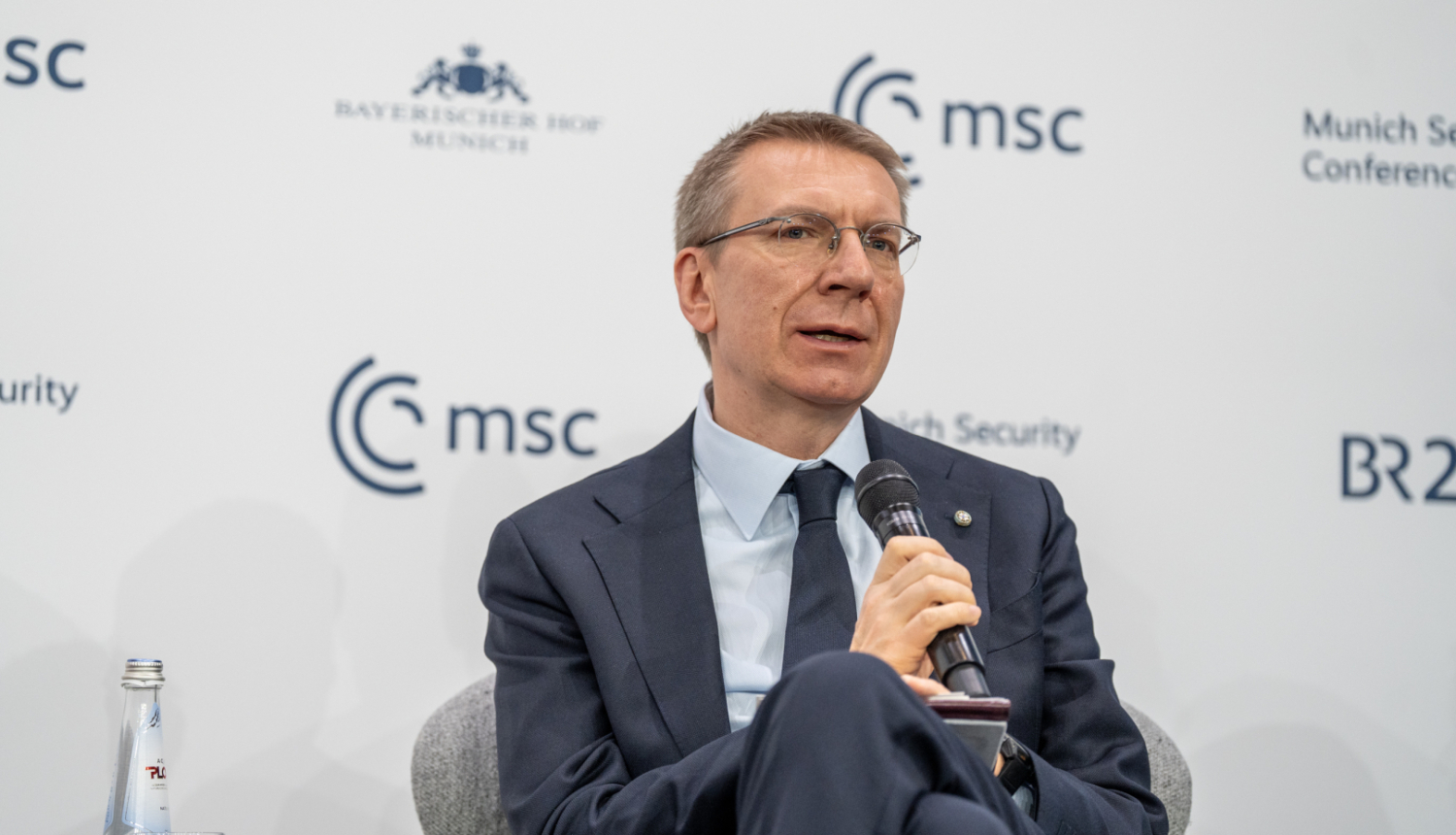
From 13 to 15 February, President Edgars Rinkēvičs took part in the Munich Security Conference. This year, the conference focused on cooperation and differences of opinion between Europe and the United States, the prospects for achieving a lasting peace in Ukraine and the necessary pressure on Russia, as well as discussions on other pressing geopolitical challenges.
On 13 February, President Edgars Rinkēvičs, together with the President of Finland, Alexander Stubb, participated in a discussion organised by the NATO Strategic Communications Centre of Excellence entitled “The New Great Game: Rethinking Information, Technology and Global Power.” The Presidents of Latvia and Finland, along with representatives of technology companies, researchers and experts, discussed the impact of artificial intelligence and emerging technologies on the information environment, geopolitical competition in technological development, and the opportunities and risks posed by technology in shaping public opinion, including in the education process.
On 14 February, President Edgars Rinkēvičs joined the President of the Czech Republic, Petr Pavel, the Prime Minister of Denmark, Mette Frederiksen, the Prime Minister of Croatia, Andrej Plenković, and the Prime Minister of the Netherlands, Dick Schoof, in a discussion on support for Ukraine entitled “Ukraine: Futures’ Frontline.” The President of Latvia underscored the importance of continued support for Ukraine while maintaining political and economic pressure on Russia, which shows no willingness to achieve peace.
“We do not see any signs from Russia to accept any kind of offers, any kind of possible peace deals. We can see only diplomatic gaming and rejection. The only way how we can do our best to get peace in 2026 would be by increasing pressure on Russia, both political and economic through sanctions, fighting the shadow fleet and, of course, supporting Ukraine. I wish and keep my fingers crossed that the USA efforts together with European leaders would be productive. However, I also see that Russia rejecting all kinds of ideas and not willing to sign up to peace we will have to look not only at diplomacy but also at the pressure,” said E. Rinkēvičs.
The President highlighted the importance of security guarantees for Ukraine in peace negotiations in order to achieve a lasting peace. “Very solid security guarantees are essential to securing a lasting peace. It is also about our own ability to build such defence industry and such capabilities in Europe that can withstand whatever attack from Russia. We have discussed that Europe has a lot of military assets. We do have some problems with managing them. We also must acknowledge that for at least some coming years the United States are indispensable. We need to get serious to boaster our defences and also be credible when it comes to any security guarantees to be agreed if there is peace,” stated E. Rinkēvičs.
During the Munich Security Conference, President Edgars Rinkēvičs also met with the President of Moldova, Maia Sandu. The two sides discussed active political dialogue and close bilateral cooperation, as well as the Moldovan Government’s consistent approach and progress in reforms related to European Union integration. The discussion also focused on Moldova’s experience in countering Russia’s attempts to interfere in electoral processes. “It is important to remain vigilant and closely coordinated in the face of Russia’s hybrid threats, including in the context of the Saeima elections scheduled to take place in Latvia this year,” noted E. Rinkēvičs.
The President also met with the leadership of the US defence industry company “Anduril Industries” to discuss opportunities for cooperation in developing key military capabilities.
On 15 February, President Edgars Rinkēvičs participated in the Munich Security Conference main programme panel discussion “Europeans Assemble: Reclaiming Agency in a Rougher World” together with the EU High Representative for Foreign Affairs and Security Policy, Kaja Kallas, NATO Deputy Secretary General Radmila Šekerinska, and the French Minister for Europe, Benjamin Haddad. “We tend to talk about speeches that are presented outside Europe. What we need to do is to speak about what Europe must do to become stronger. Firstly, hope is not a strategy. Secondly, we need calm pragmatism to carry on with the things we have agreed to do a long time ago – defence, digital sovereignty and energy independence. Those three things we need to do if we want to get a strong Europe. And finally, a strong Europe is of our interest and of our allies, but a strong Europe not something our adversaries want to see. One of the profound bases of a democratic and liberal order is that we agree to disagree. Sometimes the debate can be heated but at the end of the day the important thing is to find common ground. I still hope that with all the differences we can reform and transform transatlantic relations through cooperation. It is our own fault that we have neglected defence and other things for so long. Energy dependence in Europe on Russian gas and oil was profound just a couple of years ago,” President Rinkēvičs stated during the discussion.
Concluding his participation in the Munich Security Conference, the President took part in a discussion organised by the Atlantic Council entitled “Closing Time: Mapping the Transatlantic Path after Munich.”
