



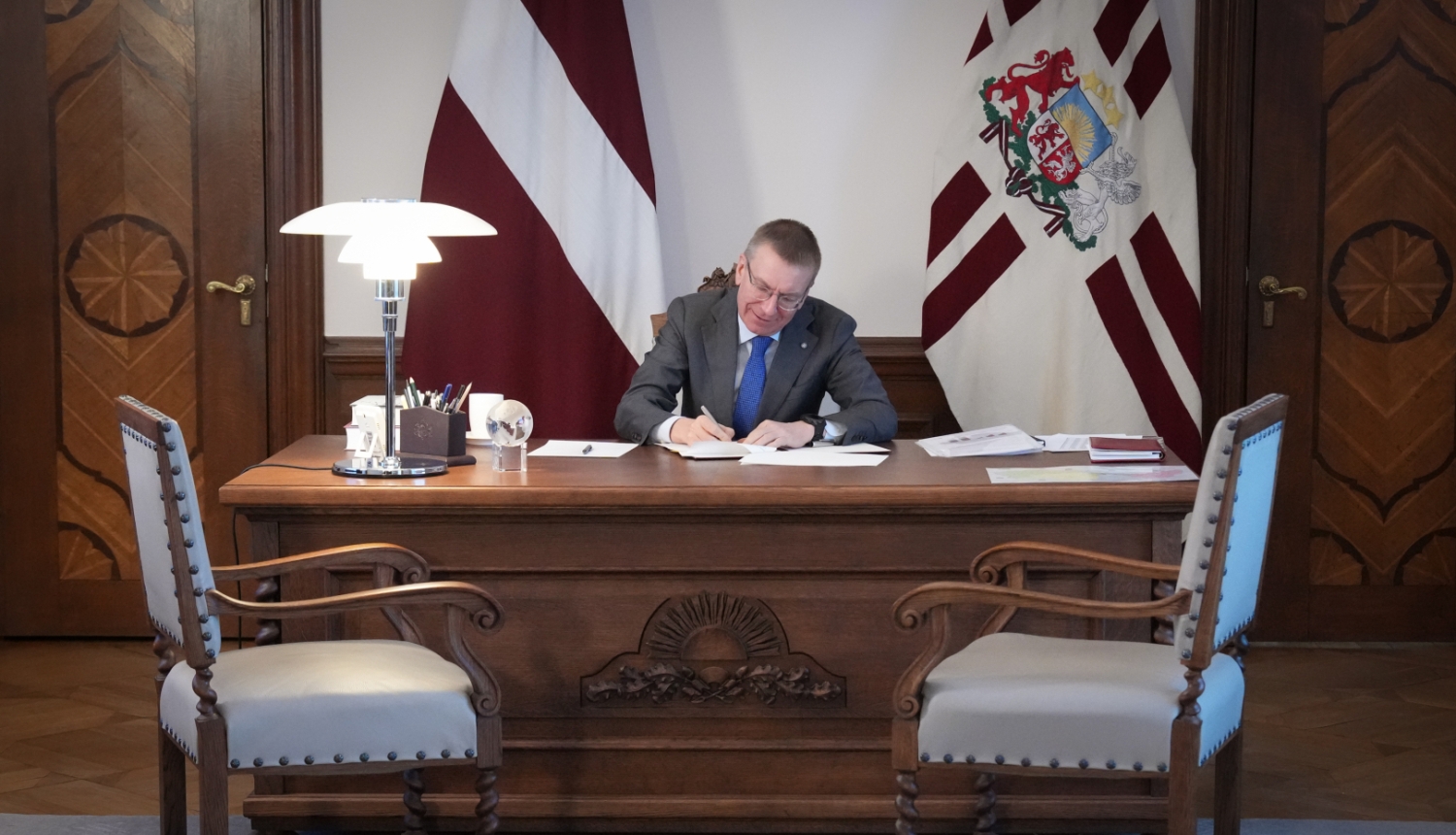
On 19 June, President Edgars Rinkēvičs referred back to the Saeima for a second review the Immigration Law, which was adopted on 11 June 2026.
“The legislative drafting materials indicate that 158 proposals were submitted for consideration during the third reading of the bill in the Saeima. These included both technical amendments and proposals introducing fundamentally new legal provisions, including those concerning a foreign national’s right to apply for a temporary residence permit if they have made investments in the economy of the Republic of Latvia as provided for by law. In this area, several issues emerge that the Saeima should reconsider,” the President wrote in a letter to the Speaker of the Saeima, Daiga Mieriņa.
In his letter to the Speaker of the Saeima, the President notes that, pursuant to Article 27(1)(36) of the Immigration Law adopted by the Saeima, a foreign national may apply for a temporary residence permit for a period of up to five years in accordance with the procedure set forth in the Immigration Law, provided that they have concluded an agreement and transferred at least EUR 150,000 as an investment for a period of no less than five years to a state-established alternative investment fund manager, and have paid EUR 10,000 into the state budget. A temporary residence permit issued to a foreign national remains valid if, throughout its period of validity, the state-established alternative investment fund manager confirms that the investment agreement has not been terminated and that the remaining investment balance is not less than EUR 150,000.
The legislator placed significant emphasis on ensuring that the options provided by the law to apply for temporary residence permits are consistent with Latvia’s national interests and security considerations. This is evidenced, for example, by the special provisions included in the law restricting the rights of citizens of the Republic of Belarus and the Russian Federation to apply for and obtain temporary residence permits. The importance of national security considerations is further demonstrated by the fact that the legislator has already initiated amendments to the law before it has even entered into force. In particular, the law in its original wording did not expressly restrict the rights of citizens of Belarus and Russia to apply for temporary residence permits in the situation provided for in Article 27(1)(36). The legislator should therefore ascertain whether references to Article 27(1)(36) should also be incorporated into other articles of the law. Likewise, the legislator must ensure that the regulation contained in Article 27(1)(36) of the Law is complete and sufficient, and that no delegation of authority to the Cabinet of Ministers is required, for example, to address the verification of the origin of funds used for investments and to determine the purposes for which such investments may be used,” the President’s letter states.
“I see an opportunity for the Saeima to reassess whether it would be advisable to establish clearly defined statutory provisions under which citizens of member states of the North Atlantic Treaty Organization, the Organisation for Economic Cooperation and Development, the European Economic Area, and, possibly, other countries friendly to Latvia included in a list approved by the Cabinet of Ministers, could apply for temporary residence permits on the basis of purchasing real estate. I have received a similar proposal from leading representatives of the real estate sector. The legislator has the option either to specify the administrative territories of the Republic of Latvia where such property purchases are permitted, together with property value thresholds and other criteria, or to delegate this task to the Cabinet of Ministers,” the President’s letter further notes.