



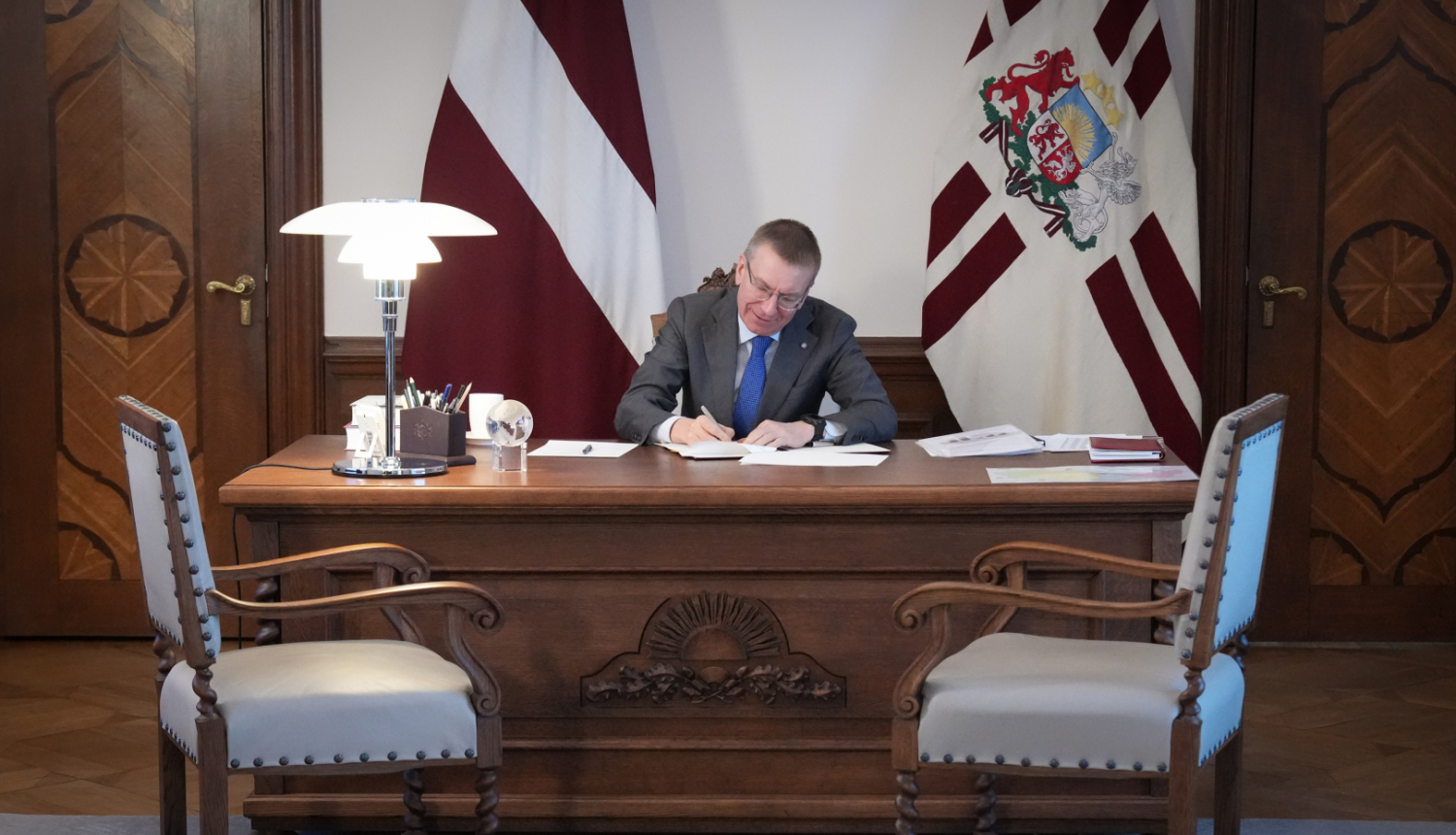
On 30 January, President Edgars Rinkēvičs referred back to the Saeima for a second review the law “Amendments to the Education Law”, which was adopted by the Saeima on 22 January 2026.
“Following a thorough review of the text of the Law, the preparatory materials, and the views expressed at the meeting dedicated to examining the request for reconsideration of the Law, the legislature’s decision to take targeted steps to improve the quality of education is to be welcomed. The clarification of terminology used in the Education Law to describe forms of education is a positive development, as is the clarification of responsibilities and principles of cooperation among those involved in the education process, including parents, as well as the task assigned to the Cabinet of Ministers to establish clearer and uniform quality requirements for distance learning. The legislator’s intention to promote the choice of a form of education that best serves the interests of the child at a particular age and in a specific situation is also commendable,” the President wrote in his letter to the Speaker of the Saeima, Daiga Mieriņa.
At the same time, the President draws attention to the fact that such significant changes to the legal regulation of education, which directly affect students and their parents, as well as local governments and educational institutions, must be implemented with particular care. This requires ensuring sufficient legal clarity, predictability, and reasonable timeframe for implementation, so that all parties involved are able to prepare adequately.
“Under the current law, the new regulation governing the completion of the first stage of general basic education through distance learning for children who plan to begin school in the 1st grade is to apply as of 1 September this year. This means that the Cabinet of Ministers and local governments have a very limited amount of time to prepare for the implementation of the changes. Meanwhile, families who must decide on the start of their children’s schooling are facing uncertainty as to what the procedures and criteria will be for access to distance learning and home education. It should also be taken into account that, alongside the implementation of the changes provided for in the law, a reform of the education funding model is being carried out, which may make it difficult for both parents and educational institutions to understand in a timely and well-informed manner the potential implications of the new regulation and to prepare for it appropriately,” the President said in his letter.
In the President’s view, given that key elements of the new regulation, including the procedures and criteria for assessments by local government, are still to be set out in Cabinet of Ministers regulations, concerns arise as to whether the planned changes can be implemented in full and with due quality by 1 September this year. It is imperative that the inadequate implementation of a regulation aimed at strengthening the quality of education does not hinder the effective safeguarding of the child’s best interests. Therefore, the legislator should consider commencing the application of the changes provided for in the law at a later date rather than on 1 September 2026. At the same time, it would not be advisable to revise the deadline set in the law for the adoption of Cabinet of Ministers regulations on the procedures and criteria by which local governments assess whether distance learning or home education is in the child’s best interests. This deadline is currently set for 15 May 2026. The timely drafting of these regulations is an essential prerequisite for the successful implementation of the changes, as regulations adopted in good time ensure legal clarity and predictability for families, local governments and educational institutions, and allow for proper preparation for the practical application of the new arrangements.
“The legislator has decided to regulate the possibility of providing home education within the Education Law. Specifically, the law stipulates that the first stage of a general basic education programme may be delivered through home education for those learners who have received an assessment by the local authority confirming that, for one academic year, due to special circumstances (social, health-related, educational accessibility or other significant circumstances), completing the education programme at home is in the child’s best interests. (..) At the same time, the law stipulates that the decision on the admissibility of this form of education will be taken by the local government, rather than by the head of the educational institution, as has been the case until now. In light of the above, when preparing for the implementation of the changes provided for in the law, it is necessary to ensure that, given the same objectively justified circumstances, the change in the decision-making authority with regard to the possibility of providing home education does not in itself significantly affect the outcome of this assessment. Furthermore, given that the newly introduced Article 8, paragraph 2.2 of the Education Law and the local government's assessment apply to both distance learning and home schooling, while the transitional period provided for in Article 9 of the Law applies only to distance learning for the first stage of general basic education, it is necessary to assess whether a comparable transitional period is also required in relation to the local government's assessment of home education,” the President writes in his letter.
Attached is President Edgars Rinkēvičs' letter No. 32 of 30 January 2026 regarding the referral of the law “Amendments to the Education Law” for a second review.